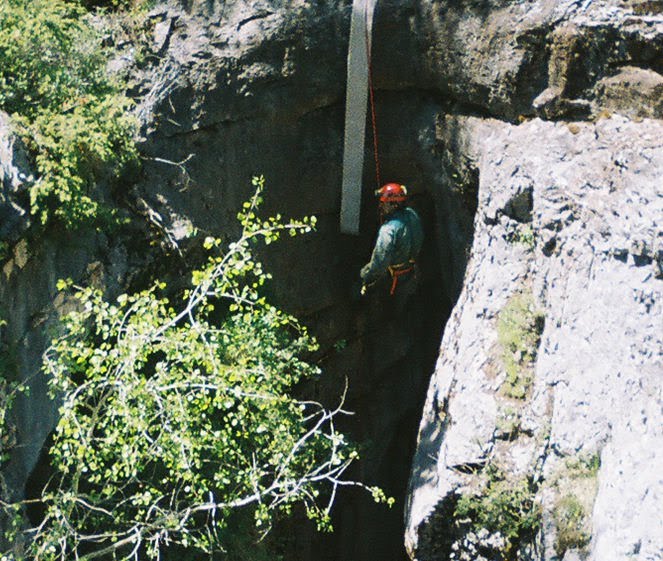
So what do you think about headlamps --- Rechargeable or disposable batteries?
There are pros and cons to both. In the world of disposable batteries, standard AA or 9volt batteries have come a long way in development. They last longer than they used to and it is easy to carry extras without too much difficulty.
With the advent of LED lamp technology, the current draw on batteries has been reduced greatly. If you are fortunate enough tho own an LED type headlamp that operates off of disposable batteries, you just need to carry a set of spares for most caving trips.
The disadvantage of disposable batteries is the added weight to you caving pack with the addition of extra batteries.
If this is a concern, the rechargeable battery type my suit you better. By utilizing this type of headlamp, there is less need to carry spares. If you live by the rule of 3 light sources on each caving trip (and who doesn't?), you will have extra light sources to use if the rechargeable unit dies. You will probable still have to carry some spare batteries for the spare light sources as well but the number is reduced.
The rechargeable type lasts quite long, and can always be charged at camp for the next day. The are usually smaller and lighter battery packs as well.
I use a Stenlight and charge it with a DC/AC inverter at camp. This works well for me.
Hope this helps a little.
Sunday, January 31, 2010

Tuesday, January 19, 2010
Boots For Caving – What Should I Wear?
Depending on the area in which you cave, boot selection will vary. Just remember, whatever you wear, it has to be something dedicated to the sport of caving. These boots will not be good for anything else after just one caving trip. The tough environment of jagged rocks, slippery mud, water, and other unseen obstacles will literally chew up a pair of boots in record time.
If you cave in a wet environment, the boots should be water proof. A lot of European cavers use “Wellys”. They are really Hunter Wellington Boots and are made of solid rubber. In my area of the world we called them galoshes. They will definitely keep out the water. They aren’t very warm though, so if you need warmth and dryness use multiple layers of wool socks.
If you don’t have a lot of money, you can go the Army surplus store and pick up some military boots cheap. Waterproof them, and wear them until they wear out.
You can spend good money on quality hiking boots with Goretex and/or Thinsulate. They will keep you dry and warm. Keep in mind that when crawling on your hands and knees, the tops of the boots and the toes will wear out very quickly. Some type of rubber toes works well to alleviate this.
The boots need to have good tread on the soles. Many caves are very muddy in places and that mud will make it very difficult to traverse if the soles of you boots have inadequate tread. (HINT – carry a putty knife along with you to clean off mud as well as use as a hand hold in tight, semi-vertical, muddy crawls)
Be prepared to replace your boots sooner than you would normally do hiking boots. Make sure they are comfortable and have adequate ankle support. You don’t want to twist an ankle deep in the bowels of a cave. Returning to the surface will be painful and long.
Happy Caving!!!
If you cave in a wet environment, the boots should be water proof. A lot of European cavers use “Wellys”. They are really Hunter Wellington Boots and are made of solid rubber. In my area of the world we called them galoshes. They will definitely keep out the water. They aren’t very warm though, so if you need warmth and dryness use multiple layers of wool socks.
If you don’t have a lot of money, you can go the Army surplus store and pick up some military boots cheap. Waterproof them, and wear them until they wear out.
You can spend good money on quality hiking boots with Goretex and/or Thinsulate. They will keep you dry and warm. Keep in mind that when crawling on your hands and knees, the tops of the boots and the toes will wear out very quickly. Some type of rubber toes works well to alleviate this.
The boots need to have good tread on the soles. Many caves are very muddy in places and that mud will make it very difficult to traverse if the soles of you boots have inadequate tread. (HINT – carry a putty knife along with you to clean off mud as well as use as a hand hold in tight, semi-vertical, muddy crawls)
Be prepared to replace your boots sooner than you would normally do hiking boots. Make sure they are comfortable and have adequate ankle support. You don’t want to twist an ankle deep in the bowels of a cave. Returning to the surface will be painful and long.
Happy Caving!!!
Monday, January 18, 2010
What Type Of Helmet Is Best?
You must wear a helmet! They are not an accessory! Countless lives have been saved by helmets.
The choice of helmet is mostly personal preference but make sure you stay with a recognized brand of mountaineering, climbing or caving helmet. All these brands are certified for impact and will go far to save your life.
Petzl, Black Diamond, C.A.M.P USA Armour, Mammut, Kong, Edelrid and PMI manufacture great outdoors helmets. Choose a color or style that suits you. If you will be attaching a light source or camera to it, make sure that style accepts it.
Many helmets utilize attachment clips on the side to securely hold the strap of a head lamp. Others will have to be modified to hold a fixed light source or camera mount on the front. You may want to just attach a small flashlight to one side with an available flashlight mount.
Do not use a bicycle helmet, hard hat, boarding or skiing helmet. These helmets are specifically made for their individual sport. They may be more bulky, or not fit as tightly as you would need in a climbing or caving situation.
So, whether you are climbing rocks, caving deep into a mountain, mountaineering or canyoneering, you need a good helmet that will serve you for years.
One other thing! If you take a fall, your helmet as well as your harness, rope, attachment devices, ascenders and descenders need to be inspected for damage and replaced if necessary. The helmet especially needs inspection and if there are any signs of cracks, punctures or other scars – REPLACE IT! It will NOT hold up to another fall!
The choice of helmet is mostly personal preference but make sure you stay with a recognized brand of mountaineering, climbing or caving helmet. All these brands are certified for impact and will go far to save your life.
Petzl, Black Diamond, C.A.M.P USA Armour, Mammut, Kong, Edelrid and PMI manufacture great outdoors helmets. Choose a color or style that suits you. If you will be attaching a light source or camera to it, make sure that style accepts it.
Many helmets utilize attachment clips on the side to securely hold the strap of a head lamp. Others will have to be modified to hold a fixed light source or camera mount on the front. You may want to just attach a small flashlight to one side with an available flashlight mount.
Do not use a bicycle helmet, hard hat, boarding or skiing helmet. These helmets are specifically made for their individual sport. They may be more bulky, or not fit as tightly as you would need in a climbing or caving situation.
So, whether you are climbing rocks, caving deep into a mountain, mountaineering or canyoneering, you need a good helmet that will serve you for years.
One other thing! If you take a fall, your helmet as well as your harness, rope, attachment devices, ascenders and descenders need to be inspected for damage and replaced if necessary. The helmet especially needs inspection and if there are any signs of cracks, punctures or other scars – REPLACE IT! It will NOT hold up to another fall!
Wednesday, January 13, 2010
Vertical Caving vs Rock Climbing
What are the differences between rock climbing and vertical caving? They both require ropes. They both require harnesses and devices such as carabiners and screw links. They both will utilize bolts and other wall or rock attachment devices. So, what makes one different from the other?
Let's start off with rock climbing, The rope a climber uses is of the dynamic variety. It stretches when a shock load is applied to it. Climbers use these ropes as a safety by attaching it to themselves and carrying it up the rock face with them. Someone at the bottom (the belayer) holds on to the rope. When the climber gets to a certain point on the wall, they attach a cam, bolt, or other attachment device to the wall, hook a carabiner through it and slip the rope through that. They then continue on up the wall, repeating these steps every so often.
If the climber should slip and fall, they would fall a distance twice the length of rope from where they are to the last attachment point. The rope would be belayed or held by the person at the bottom. The rope will stretch and absorb the shock of the fall. The belayer has the rope inserted through some form of a belay device such as an ATC or figure eight. These are friction devices that lock on the rope to help the belayer "catch" the climber.
I vertical caving, technical rope work, rescue situations and arbor rope work, the rope utilized is of the static variety. This rope does not stretch but is much more durable that the dynamic type. When using this type of rope, one never uses it as a safety to catch a falling person. To do so could cause extreme harm to that person.
Generally, these situations call for the rope to be ascended and descended as a method of getting up and down the wall, cliff, pit, tree etc. The rope is tied off at the top of the climb and then is either descended to get to the bottom of a pit or vertical cave - or - used to ascend a tree, structure or other location.
To descend, one must use a descender type device such as a figure eight, rack type descender or bobbin type descender. These are attached to the harness and then to the rope. The act of abseiling or rappelling the rope to the bottom is controlled by the amount of friction applied to the rope.
When ascending the rope, one uses a rope ascending system. It utilizes ascenders which slide up the rope easily but catch when coming down the rope. They are attached to the climber via the harness as well as either the leg or hand. There a rope walking systems, sit-stand (frog) systems and others. When used correctly these systems can easily navigate a rope in very short order.
So, although they utilize some of the same equipment, they are vastly different types of rope work. When choosing either of these sports, make sure you have the right gear for the right type of climbing.
Let's start off with rock climbing, The rope a climber uses is of the dynamic variety. It stretches when a shock load is applied to it. Climbers use these ropes as a safety by attaching it to themselves and carrying it up the rock face with them. Someone at the bottom (the belayer) holds on to the rope. When the climber gets to a certain point on the wall, they attach a cam, bolt, or other attachment device to the wall, hook a carabiner through it and slip the rope through that. They then continue on up the wall, repeating these steps every so often.
If the climber should slip and fall, they would fall a distance twice the length of rope from where they are to the last attachment point. The rope would be belayed or held by the person at the bottom. The rope will stretch and absorb the shock of the fall. The belayer has the rope inserted through some form of a belay device such as an ATC or figure eight. These are friction devices that lock on the rope to help the belayer "catch" the climber.
I vertical caving, technical rope work, rescue situations and arbor rope work, the rope utilized is of the static variety. This rope does not stretch but is much more durable that the dynamic type. When using this type of rope, one never uses it as a safety to catch a falling person. To do so could cause extreme harm to that person.
Generally, these situations call for the rope to be ascended and descended as a method of getting up and down the wall, cliff, pit, tree etc. The rope is tied off at the top of the climb and then is either descended to get to the bottom of a pit or vertical cave - or - used to ascend a tree, structure or other location.
To descend, one must use a descender type device such as a figure eight, rack type descender or bobbin type descender. These are attached to the harness and then to the rope. The act of abseiling or rappelling the rope to the bottom is controlled by the amount of friction applied to the rope.
When ascending the rope, one uses a rope ascending system. It utilizes ascenders which slide up the rope easily but catch when coming down the rope. They are attached to the climber via the harness as well as either the leg or hand. There a rope walking systems, sit-stand (frog) systems and others. When used correctly these systems can easily navigate a rope in very short order.
So, although they utilize some of the same equipment, they are vastly different types of rope work. When choosing either of these sports, make sure you have the right gear for the right type of climbing.
Tuesday, January 12, 2010
First Thing To Do When You Leave For A Caving Or Climbing Trip!
What is the first thing one should do when planning a climbing or caving trip? Tell someone (or more than just someone) exactly where you will be. As we all get excited about leaving for a few days, we get wrapped up in packing gear, gassing up the truck, buying groceries, and just plain getting amped up. We may tell someone the general area in which we are going, but never really get down to giving them the details.
In my experience, phone and pager service rarely works when I get up into the mountains. Your loved ones need to know precisely where you are going to camp and how long you plan on being gone (and what do do if they do not hear from you by that time).
What are the nearest towns, phone numbers of police or emergency rescue folks in the area, directions to get there, maps, camp ground names, cave names (if applicable) and rock formation names (if applicable)? These are a must!
Also, tell them exactly what course of action is required of them if they do not hear from you. Should they call the police, people in the area etc?
All of these precautions may just save your life or the life of someone with you. Rescuing people from the base of cliffs and from deep inside a cave is laborious, difficult, time consuming and requires special skills that not all police or fire personnel are equipped to handle. Know who can and will be available in case of an emergency!
Cave and Climb Safely - We all want to life to do it again!
In my experience, phone and pager service rarely works when I get up into the mountains. Your loved ones need to know precisely where you are going to camp and how long you plan on being gone (and what do do if they do not hear from you by that time).
What are the nearest towns, phone numbers of police or emergency rescue folks in the area, directions to get there, maps, camp ground names, cave names (if applicable) and rock formation names (if applicable)? These are a must!
Also, tell them exactly what course of action is required of them if they do not hear from you. Should they call the police, people in the area etc?
All of these precautions may just save your life or the life of someone with you. Rescuing people from the base of cliffs and from deep inside a cave is laborious, difficult, time consuming and requires special skills that not all police or fire personnel are equipped to handle. Know who can and will be available in case of an emergency!
Cave and Climb Safely - We all want to life to do it again!
Monday, January 11, 2010
Facebook Page Now On Line!
Climb and Cave is growing! We have published a Facebook page now and are working on getting more and more sponsors. This should increase the quantity of equipment and gear available as well a better choice for pricing. Look around and let us know if there is anything we can do!
Wednesday, December 23, 2009
Caving - Exploring The Dark Side Of Life.
Well here it is, the middle of winter, here in Colorado. Snow all over the place and I'm thinking about summer and fall outdoor sports I'll be doing next year! One of the sports I love to do is Caving! Horizontal of vertical caving can be a great way to experience something you may have never experienced before. You may see things very few people have ever seen. Think of it as a vast, unexplored frontier.
When caving, one assumes a feeling of awe. It makes your imagination run amok. You think of how long these formations have been around, what formed them, the fact that they exist in total darkness all day, every day (except when visited by people such as you). It truly does spark the wonder in a person! You get the feeling of being small and unimportant at the same time some of the tight passageways make you feel huge!
In Colorado, as well as other places, many of the caves have running water, underground lakes and streams and even large waterfalls. The whole existence of this underground world, with it's labyrinths, tunnels, cliffs, large open cathedrals, and tight crawls makes you ponder just how little we know about the environment around us!
If you have the time this next summer or fall, get hold of a local Grotto or caving group. Tell them you are interested in going caving and would like to get to know more about this sport. Go to some Grotto meetings, learn as much as you can about the formation of caves. You will also learn how to protect and preserve these beautiful caverns for future generations to enjoy. They are a very fragile ecosystem and without the care of the dedicated people of the NSS and the local Grottos they could be damaged and ruined forever.
I hope I have sparked an interest in caving or rekindled a previous enthusiasm for this sport. Till next time - "Every Day Underground is a Good Day"
When caving, one assumes a feeling of awe. It makes your imagination run amok. You think of how long these formations have been around, what formed them, the fact that they exist in total darkness all day, every day (except when visited by people such as you). It truly does spark the wonder in a person! You get the feeling of being small and unimportant at the same time some of the tight passageways make you feel huge!
In Colorado, as well as other places, many of the caves have running water, underground lakes and streams and even large waterfalls. The whole existence of this underground world, with it's labyrinths, tunnels, cliffs, large open cathedrals, and tight crawls makes you ponder just how little we know about the environment around us!
If you have the time this next summer or fall, get hold of a local Grotto or caving group. Tell them you are interested in going caving and would like to get to know more about this sport. Go to some Grotto meetings, learn as much as you can about the formation of caves. You will also learn how to protect and preserve these beautiful caverns for future generations to enjoy. They are a very fragile ecosystem and without the care of the dedicated people of the NSS and the local Grottos they could be damaged and ruined forever.
I hope I have sparked an interest in caving or rekindled a previous enthusiasm for this sport. Till next time - "Every Day Underground is a Good Day"
Thursday, December 17, 2009
Climbing Ropes - Types, Care, and Use.
Climbing ropes are available in two basic configurations. There are static ropes and dynamic ropes. Do not confuse the two different types of rope! Once a rope is purchased, one should mark the rope accordingly. It is difficult to distinguish between the static and dynamic ropes just upon visual inspection.
I generally mark my ropes in the following manner. I use to two colors of shrink tubing. Shrink tubing is a plastic tube that shrinks when heated. I slide a white piece if tubing onto the ends of the rope. I use a heat gun or similar tool to shrink the tube down tightly on the rope. Then I mark on the tubing the date the rope was purchased, the type of rope, and the length. Then I take a clear piece of tubing and slide it over the white piece and shrink it down tight over the first piece. This keeps the markings from rubbing off and makes it easily identifiable.
Static rope is designed to be used for rappelling into a pit or off the edge of a drop. It is generally used with a rope descender system and is NOT used to catch a fall. If one falls using a static rope one can rick injury or even death. Static ropes do not stretch. They are more abrasion resistant but will not protect against shock loads. Static ropes are mainly used in the caving environment, technical climbing and for rescue purposes.
Dynamic ropes ARE stretchable. They are used for general climbing and will absorb a shock load. They are designed for belaying and will absorb the shock of a falling climber. They reduce the chance of injury on the climber, belayer and any equipment used. Think of dynamic ropes as life safety ropes.
Take care of your ropes. They need to be washed if they have gotten extremely diry of muddy. The grit in dirt and mud acts as sand paper an can quickly destroy the rope's construction. Put them away dry and clean and they will last much longer.
I will talk about rope washing techniques in an future article.
I generally mark my ropes in the following manner. I use to two colors of shrink tubing. Shrink tubing is a plastic tube that shrinks when heated. I slide a white piece if tubing onto the ends of the rope. I use a heat gun or similar tool to shrink the tube down tightly on the rope. Then I mark on the tubing the date the rope was purchased, the type of rope, and the length. Then I take a clear piece of tubing and slide it over the white piece and shrink it down tight over the first piece. This keeps the markings from rubbing off and makes it easily identifiable.
Static rope is designed to be used for rappelling into a pit or off the edge of a drop. It is generally used with a rope descender system and is NOT used to catch a fall. If one falls using a static rope one can rick injury or even death. Static ropes do not stretch. They are more abrasion resistant but will not protect against shock loads. Static ropes are mainly used in the caving environment, technical climbing and for rescue purposes.
Dynamic ropes ARE stretchable. They are used for general climbing and will absorb a shock load. They are designed for belaying and will absorb the shock of a falling climber. They reduce the chance of injury on the climber, belayer and any equipment used. Think of dynamic ropes as life safety ropes.
Take care of your ropes. They need to be washed if they have gotten extremely diry of muddy. The grit in dirt and mud acts as sand paper an can quickly destroy the rope's construction. Put them away dry and clean and they will last much longer.
I will talk about rope washing techniques in an future article.
Tuesday, December 15, 2009
What To Carry In A Caving Pack
Everyone has their own idea of what might be included in their very own cave pack. Obviously, the contents depend somewhat on the length of the trip. We will focus on short day trips from 1 to 4 or 5 hours. These are the most common caving trips and should cover the majority of concerns. Overnight trips and other lengthy expeditions require much more thought and planning.
The pack should be as small as possible but still be able to include all the essential items. The other qualities I like in a pack are multiple straps, hooks and configurations for attaching it to yourself. My pack can be attached around the waist, over the shoulder, to one leg or over my back.
The following list is what I carry and can be adjusted accordingly. Colorado is a colder caving environment and has some wet, muddy caves.
I actually carry a pack inside a pack. The smaller inside one is a padded, semi waterproof case designed for either a camera, binoculars or something like that. In this case I carry small items that can be easily misplaced in the bottom of a larger pack. This includes...
putty knife (used for cleaning mud off boots or as an assist in a muddy horizontal / vertical belly crawl)
mag light with Velcro attachment loop (to attach to helmet if needed, I generally have 2 headlamps on helmet)
spare batteries and bulbs for all lights
wire hook and length of nylon cord ( to retrieve items dropped)
large trash bag and candle (to stay warm if stranded)
lighter and flints
duct tape
toilet paper
paper and sharpie
small plastic magnifying card (to read maps)
maps
camera
small first aid kit
lip balm
zip ties
zip lock bags ( I keep above items that can't get wet in zip locks as well)
All above goes into the small bag which goes into the larger bag which contains the following...
water bottle
human waste bags (Restop)
webbing
couple of locking, aluminum carabiners
power bars or snacks
beanie cap
short cord to attach pack to chicken loop on ankle if I need to drag the pack behind me
This should be fairly complete - Happy Caving!
The pack should be as small as possible but still be able to include all the essential items. The other qualities I like in a pack are multiple straps, hooks and configurations for attaching it to yourself. My pack can be attached around the waist, over the shoulder, to one leg or over my back.
The following list is what I carry and can be adjusted accordingly. Colorado is a colder caving environment and has some wet, muddy caves.
I actually carry a pack inside a pack. The smaller inside one is a padded, semi waterproof case designed for either a camera, binoculars or something like that. In this case I carry small items that can be easily misplaced in the bottom of a larger pack. This includes...
putty knife (used for cleaning mud off boots or as an assist in a muddy horizontal / vertical belly crawl)
mag light with Velcro attachment loop (to attach to helmet if needed, I generally have 2 headlamps on helmet)
spare batteries and bulbs for all lights
wire hook and length of nylon cord ( to retrieve items dropped)
large trash bag and candle (to stay warm if stranded)
lighter and flints
duct tape
toilet paper
paper and sharpie
small plastic magnifying card (to read maps)
maps
camera
small first aid kit
lip balm
zip ties
zip lock bags ( I keep above items that can't get wet in zip locks as well)
All above goes into the small bag which goes into the larger bag which contains the following...
water bottle
human waste bags (Restop)
webbing
couple of locking, aluminum carabiners
power bars or snacks
beanie cap
short cord to attach pack to chicken loop on ankle if I need to drag the pack behind me
This should be fairly complete - Happy Caving!
Monday, December 14, 2009
Basic Rock Climbing Technique
For the sake of discussion, we are talking about free climbing. Free solo climbing will not be discussed at this time.
Climbing is usually done with at least two people and sometimes more. When climbing, one person is climbing and the other belays the climber. By belay, I mean protects them from a fall. This is done with a rope. The rope is either anchored at the top of the face or drawn up the climb with a lead climber.
When anchored at the top (top roping), the rope is dropped down on both sides of the anchor, one end tied to the climber's harness and the other end controlled by the belayer. As the climber ascends, the belayer pulls up the slack in the rope through a belay device. If the climber were to fall the belayer can stop the release of rope by pulling on the rope through the belay device, thus stopping the climber's fall.
In the case of lead climbing, the rope is attached to the climber and controlled by the belayer. As the climber ascends a pitch, they attach a quickdraw (2 carbiners connected together with a short length of webbing) to an anchor on the wall and then run the rope through the other end of the quickdraw. As the climber ascends, the belayer lets out more slack in the rope. The climber continues to ascend, attach quickdraws and loop the rope through them. If the climber were to fall, the belayer would, once again, control the fall with the belay device. The climber would only fall twice the distance they are above the last anchor.
In either case, the belayer could belay them all the way down if needed. Some climbs are too long and this operation has to be done in several pitches up the face.
Equipment needed.
Harness
Helmet
Carabiners
Quickdraws
Chalk and bag
Climbing shoes
Rope
Belay devices
Anchors (either removable or permanent)
Comfortable clothing
This is just a basic list and can be improved upon over time.
Climbing is usually done with at least two people and sometimes more. When climbing, one person is climbing and the other belays the climber. By belay, I mean protects them from a fall. This is done with a rope. The rope is either anchored at the top of the face or drawn up the climb with a lead climber.
When anchored at the top (top roping), the rope is dropped down on both sides of the anchor, one end tied to the climber's harness and the other end controlled by the belayer. As the climber ascends, the belayer pulls up the slack in the rope through a belay device. If the climber were to fall the belayer can stop the release of rope by pulling on the rope through the belay device, thus stopping the climber's fall.
In the case of lead climbing, the rope is attached to the climber and controlled by the belayer. As the climber ascends a pitch, they attach a quickdraw (2 carbiners connected together with a short length of webbing) to an anchor on the wall and then run the rope through the other end of the quickdraw. As the climber ascends, the belayer lets out more slack in the rope. The climber continues to ascend, attach quickdraws and loop the rope through them. If the climber were to fall, the belayer would, once again, control the fall with the belay device. The climber would only fall twice the distance they are above the last anchor.
In either case, the belayer could belay them all the way down if needed. Some climbs are too long and this operation has to be done in several pitches up the face.
Equipment needed.
Harness
Helmet
Carabiners
Quickdraws
Chalk and bag
Climbing shoes
Rope
Belay devices
Anchors (either removable or permanent)
Comfortable clothing
This is just a basic list and can be improved upon over time.
Sunday, December 13, 2009
Basic Equipment Required For Caving
This list is by no means complete but should get the average person started. Exploring caves is a great activity and should be a memorable experience. Safety is of great concern. When going caving, be sure to let someone know where you are going and when they would expect you back. Give them numbers of agencies in the vicinity of where you will be so that they can get hold of people to locate you if you don't return on time. Always cave with at least three people. This will insure that someone can get help while another can stay with an injured person. Always carry 3 sources of light (the worst thing that can happen is to be without light).
So.. here is the list...
Helmet (with headlamp strapped or mounted to it)
Grubby clothes (old overalls or jeans)
Solid pair of boots
Gloves
Elbow and knee pads
Small pack containing the following:
Extra light sources
Water
Food (granola or power bars)
Knife
Map of cave (if applicable)
Spare batteries
Small first aid kit
Zip locks and foil (carry out waste)
Disposable camera
This equipment will not get you into vertical caving but will get you safely into and out of a horizontal cave.
Stay tuned - there will be more.....
So.. here is the list...
Helmet (with headlamp strapped or mounted to it)
Grubby clothes (old overalls or jeans)
Solid pair of boots
Gloves
Elbow and knee pads
Small pack containing the following:
Extra light sources
Water
Food (granola or power bars)
Knife
Map of cave (if applicable)
Spare batteries
Small first aid kit
Zip locks and foil (carry out waste)
Disposable camera
This equipment will not get you into vertical caving but will get you safely into and out of a horizontal cave.
Stay tuned - there will be more.....
Subscribe to:
Posts (Atom)