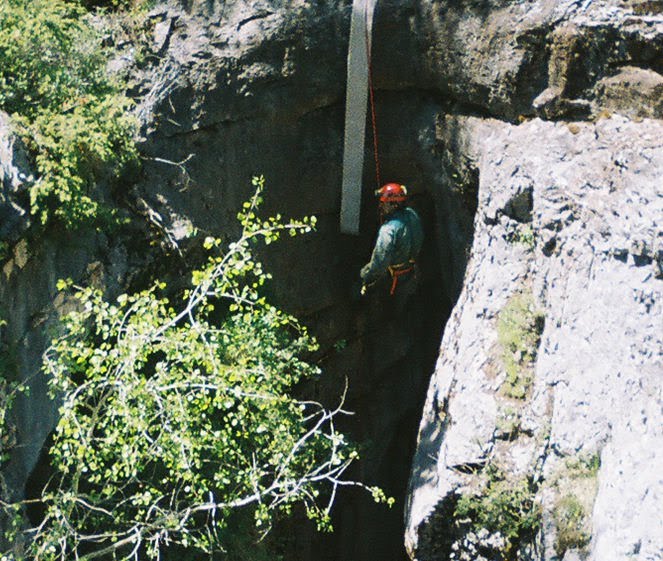
What are the differences between rock climbing and vertical caving? They both require ropes. They both require harnesses and devices such as carabiners and screw links. They both will utilize bolts and other wall or rock attachment devices. So, what makes one different from the other?
Let's start off with rock climbing, The rope a climber uses is of the dynamic variety. It stretches when a shock load is applied to it. Climbers use these ropes as a safety by attaching it to themselves and carrying it up the rock face with them. Someone at the bottom (the belayer) holds on to the rope. When the climber gets to a certain point on the wall, they attach a cam, bolt, or other attachment device to the wall, hook a carabiner through it and slip the rope through that. They then continue on up the wall, repeating these steps every so often.
If the climber should slip and fall, they would fall a distance twice the length of rope from where they are to the last attachment point. The rope would be belayed or held by the person at the bottom. The rope will stretch and absorb the shock of the fall. The belayer has the rope inserted through some form of a belay device such as an ATC or figure eight. These are friction devices that lock on the rope to help the belayer "catch" the climber.
I vertical caving, technical rope work, rescue situations and arbor rope work, the rope utilized is of the static variety. This rope does not stretch but is much more durable that the dynamic type. When using this type of rope, one never uses it as a safety to catch a falling person. To do so could cause extreme harm to that person.
Generally, these situations call for the rope to be ascended and descended as a method of getting up and down the wall, cliff, pit, tree etc. The rope is tied off at the top of the climb and then is either descended to get to the bottom of a pit or vertical cave - or - used to ascend a tree, structure or other location.
To descend, one must use a descender type device such as a figure eight, rack type descender or bobbin type descender. These are attached to the harness and then to the rope. The act of abseiling or rappelling the rope to the bottom is controlled by the amount of friction applied to the rope.
When ascending the rope, one uses a rope ascending system. It utilizes ascenders which slide up the rope easily but catch when coming down the rope. They are attached to the climber via the harness as well as either the leg or hand. There a rope walking systems, sit-stand (frog) systems and others. When used correctly these systems can easily navigate a rope in very short order.
So, although they utilize some of the same equipment, they are vastly different types of rope work. When choosing either of these sports, make sure you have the right gear for the right type of climbing.
Wednesday, January 13, 2010

Tuesday, January 12, 2010
First Thing To Do When You Leave For A Caving Or Climbing Trip!
What is the first thing one should do when planning a climbing or caving trip? Tell someone (or more than just someone) exactly where you will be. As we all get excited about leaving for a few days, we get wrapped up in packing gear, gassing up the truck, buying groceries, and just plain getting amped up. We may tell someone the general area in which we are going, but never really get down to giving them the details.
In my experience, phone and pager service rarely works when I get up into the mountains. Your loved ones need to know precisely where you are going to camp and how long you plan on being gone (and what do do if they do not hear from you by that time).
What are the nearest towns, phone numbers of police or emergency rescue folks in the area, directions to get there, maps, camp ground names, cave names (if applicable) and rock formation names (if applicable)? These are a must!
Also, tell them exactly what course of action is required of them if they do not hear from you. Should they call the police, people in the area etc?
All of these precautions may just save your life or the life of someone with you. Rescuing people from the base of cliffs and from deep inside a cave is laborious, difficult, time consuming and requires special skills that not all police or fire personnel are equipped to handle. Know who can and will be available in case of an emergency!
Cave and Climb Safely - We all want to life to do it again!
In my experience, phone and pager service rarely works when I get up into the mountains. Your loved ones need to know precisely where you are going to camp and how long you plan on being gone (and what do do if they do not hear from you by that time).
What are the nearest towns, phone numbers of police or emergency rescue folks in the area, directions to get there, maps, camp ground names, cave names (if applicable) and rock formation names (if applicable)? These are a must!
Also, tell them exactly what course of action is required of them if they do not hear from you. Should they call the police, people in the area etc?
All of these precautions may just save your life or the life of someone with you. Rescuing people from the base of cliffs and from deep inside a cave is laborious, difficult, time consuming and requires special skills that not all police or fire personnel are equipped to handle. Know who can and will be available in case of an emergency!
Cave and Climb Safely - We all want to life to do it again!
Monday, January 11, 2010
Facebook Page Now On Line!
Climb and Cave is growing! We have published a Facebook page now and are working on getting more and more sponsors. This should increase the quantity of equipment and gear available as well a better choice for pricing. Look around and let us know if there is anything we can do!
Subscribe to:
Posts (Atom)